Led by the Bordeaux University Hospital and funded by VBHI as well as the Fondation pour la Recherche Médicale, the SHIVA-CogNeurophys study is conducted under the responsibility of Prof. Igor Sibon, principal investigator and interim director of VBHI, and Dr Nicolas Borderies, in collaboration with the research teams of Fabien Wagner, Fabien Lotte and Hélène Sauzéon, in particular doctoral researchers Mathilde Reynes and Manon Bourdil. The study was launched in late 2025 and currently has 7 participants.
What is SHIVA-CogNeurophys and why was it created?
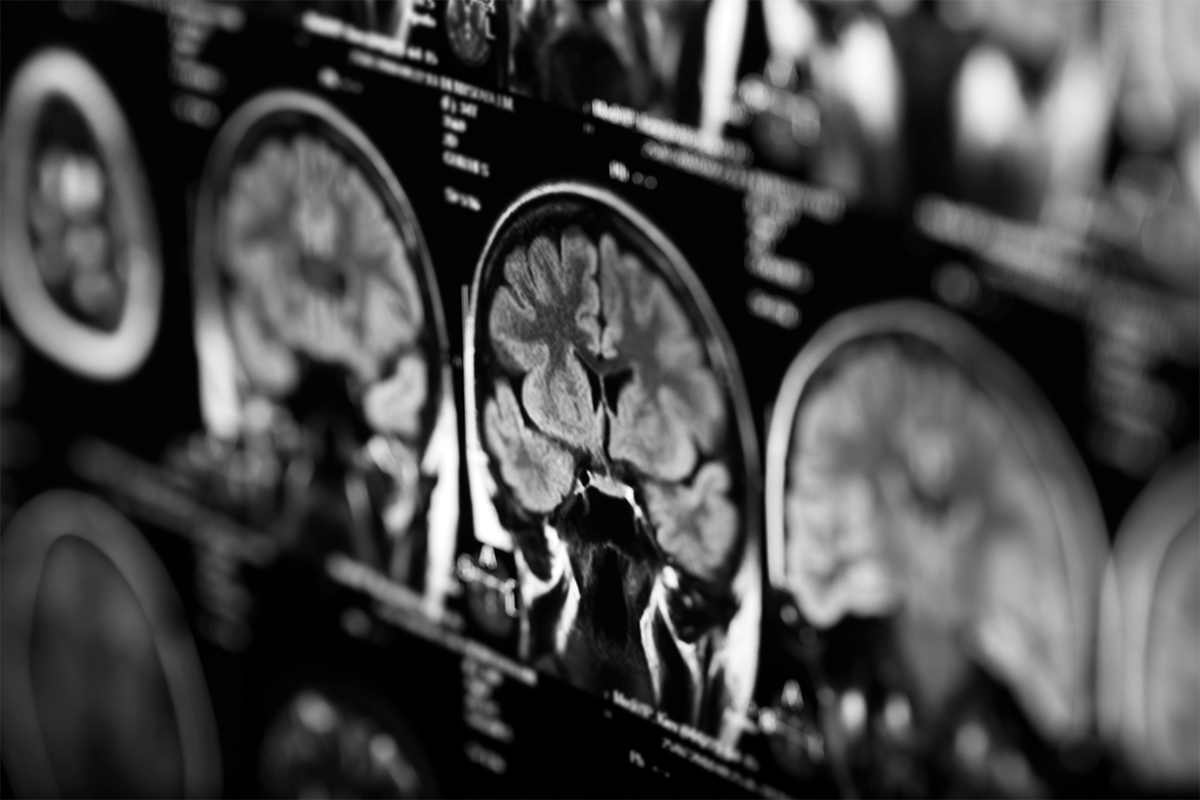
The SHIVA-CogNeurophys study aims to investigate the cognitive symptoms of cerebral small vessel disease.
Why is this important?
Cerebral small vessel disease encompasses various pathological processes affecting the small arteries, capillaries, venules and brain tissue, potentially leading to ischaemic strokes and intracerebral haemorrhages.
Symptoms may include:
- cognitive impairment,
- motor difficulties,
- neuropsychiatric symptoms.
Current treatments, as well as associated research efforts, are limited to reducing cardiovascular risk factors (such as high blood pressure, cholesterol, etc.), while cognitive symptoms* remain underexplored.
*A cognitive symptom is a sign that the brain is not functioning quite as usual, particularly in the way it processes information, thinks, or remembers (for example, problems with concentration, memory lapses, difficulty finding the right words, thinking that feels slowed or foggy, or difficulties planning and organising everyday tasks).
Thus, the SHIVA-CogNeurophys study aims to gain a better understanding of memory and attention capacities in people with cerebral small vessel disease.
To this end, we are conducting a study involving patients already enrolled in the SHIVA research programme to investigate how this disease may influence these brain functions.
What are the expected benefits of such a study?
The SHIVA-CogNeurophys study will help improve the care and well-being of patients with cerebral small vessel disease by:
- providing a better understanding of the onset of cognitive impairment and the way in which it affects brain rhythms,
- investigating the effects of transcranial alternating current stimulation, which makes it possible to modulate certain brain rhythms and could potentially lead to a temporary improvement in cognitive performance in the most severely affected patients,
- offering cognitive training programmes tailored to the individual needs of older adults and based on artificial intelligence. This would promote the use of non-pharmacological interventions and better account for the diversity of ageing profiles. Accessible from home and without fixed schedules, this approach would place minimal burden on patients.
How does participation take place?
The SHIVA-CogNeurophys study is offered to:
- 80 patients from the SHIVA cohort diagnosed with cerebral small vessel disease,
- 20 young participants (between 18 and 35 years old) who are healthy.
Participation includes five visits to Hôpital Pellegrin at the CHU de Bordeaux and lasts six months.
Visits are scheduled as follows:
- an inclusion visit with the signing of informed consent,
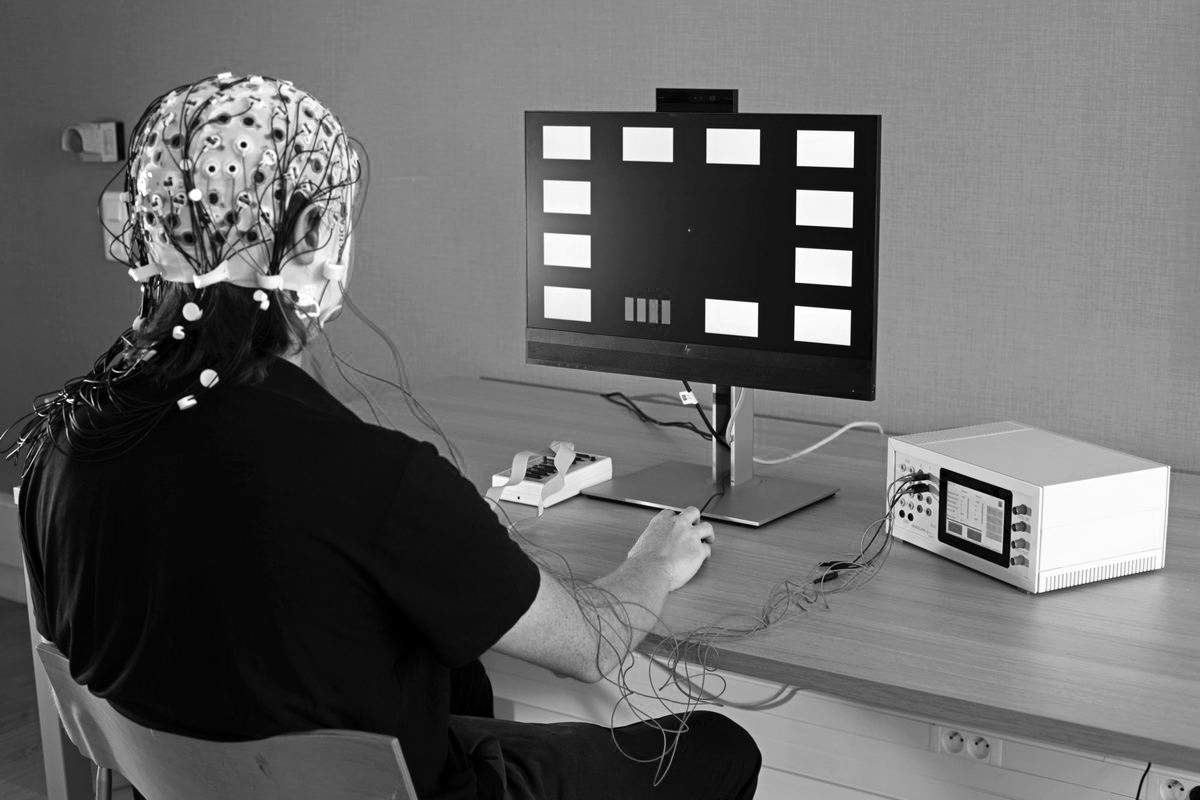
- Day 0: Visit 1 before training, including an electroencephalogram (EEG), memory tests and brain stimulation,
- Day 7: Visit 2 before training, including EEG, memory tests and brain stimulation,
- Days 14 to 25: Home-based cognitive training (8 hours spread over 10 days) and a battery of tests one day before and one day after the training,
- Day 26: Visit 3 after training, including EEG, memory tests and brain stimulation,
- Day 33: Visit 4 after training, including EEG, memory tests and brain stimulation,
- Six months after Day 0: home-based test battery and satisfaction questionnaire.
What is an Electroencephalogram (EEG) and what is it used for?
An electroencephalogram (EEG) is a medical test that records the electrical activity of the brain.
The brain operates through electrical signals that are constantly exchanged between neurons. The EEG captures these signals using small sensors (electrodes) placed on the scalp, without any pain or injections. The result is a sort of “curve” that represents these electrical activities, similar to how an electrocardiogram works for the heart.
This test is mainly used to detect and monitor epilepsy, investigate sleep disorders, explore certain types of loss of consciousness, severe headaches, or cognitive impairments.
How does brain stimulation work and what is its purpose?
Transcranial alternating current stimulation delivered during a cognitive task is a non-invasive approach used to entrain neuronal oscillations. It can help restore disrupted neuronal oscillations in cognitive disorders.
This may lead to improvements in associated neurological functions by facilitating local information processing and plasticity, as well as long-range communication between different brain regions.
In practice, this procedure applies a low-intensity sinusoidal electrical current to the scalp. This is thought to slightly modulate the membrane potential of neighbouring cortical neurons and increase the likelihood that they fire at a particular phase of ongoing oscillations, a phenomenon known as “neuronal entrainment”.
For the SHIVA-CogNeurophys study, brain stimulation lasts 25 minutes and is delivered either under an active stimulation condition or under a control (sham) condition.
What is Cognitive Training at Home?
Cognitive training at home is a series of exercises carried out on a computer connected to the internet.
It consists of:
- Cognitive tests lasting 1 hour and 45 minutes to work on attention, mental flexibility, enumeration, memorization, and inhibition by clicking on a key or mouse.
- Attention training of 2×30 minutes per day, which can be paused and resumed.
What is assessed during the SHIVA-CogNeurophys study?
Several additional assessments are carried out throughout the study:
- Participants’ cognitive and physical status at baseline,
- Participants’ quality of life and cognitive complaints (difficulties or perceived decline) throughout the study,
- Tolerance to transcranial stimulation throughout the study,
- Attention and memory abilities, with and without cognitive training, including home-based assessments throughout the study,
- Acceptability of home-based cognitive training.
A big congratulations to the clinical research associates of the study as well as Mathilde Reynes and Manon Bourdil, PhD students at VBHI, for their dedication to the patients participating in the SHIVA cohort. Their commitment and the quality of their interactions with the participants have greatly supported the recruitment for the SHIVA-CogNeurophys study!
Find out more: https://rhu-shiva.com/fr/shiva-cogneurophys/
EM