Congratulations to the VBHI awardees in the French National Research Agency (ANR) 2026 Generic Call for Proposals! Two Collaborative Research Projects (PRC) have been awarded funding. We are delighted to introduce them.
Carus
Coordinated by Dr Sébastien Salles, Research Fellow at the Centre for Magnetic Resonance of Biological Systems (CRMSB – CNRS, University of Bordeaux), together with Nadège Corbin and Aurélien Trottier, Research Engineers, in partnership with the Laboratory of Cardiovascular Disease Biology (Inserm, University of Bordeaux), headed by Professor Thierry Couffinhal, Deputy Director of VBHI, and with Dr Romain Boulestreau, as well as the ULTIM team (F. Varray, H. Liebgott) and the MYRIAD team (F. Millioz) from the CREATIS laboratory (CNRS, Inserm (U1294), INSA Lyon, Claude Bernard Lyon 1 University and Jean Monnet University of Saint-Étienne), the Carus project focuses on reconstructing collagen anisotropy using ultrasound imaging.
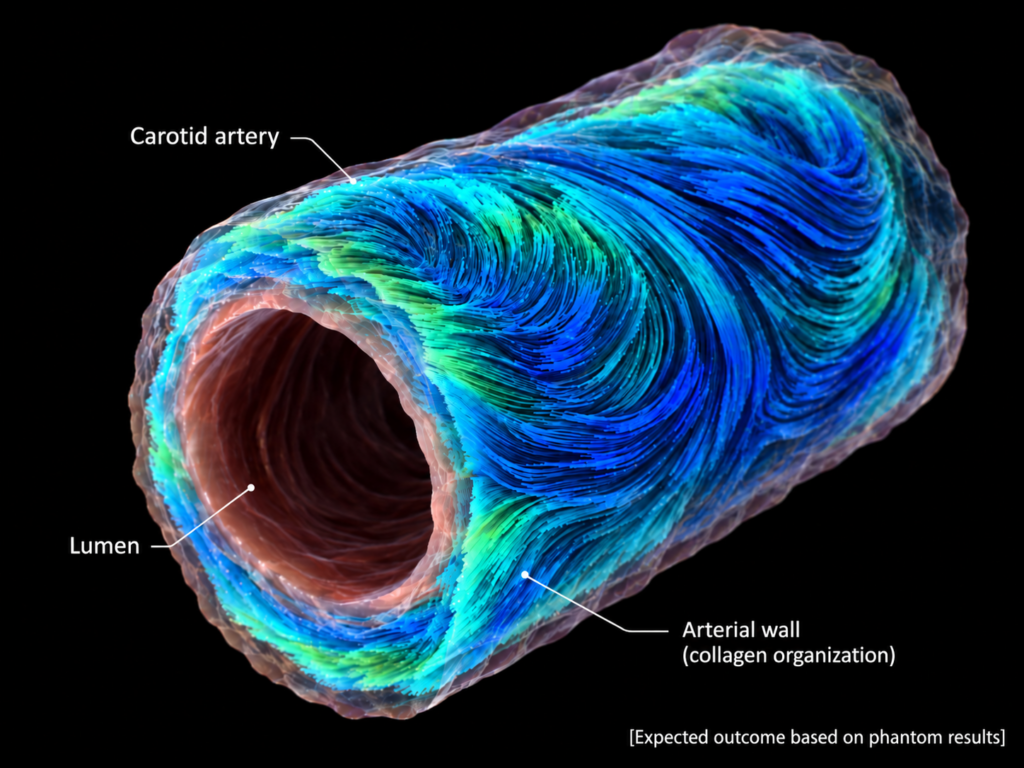
Cardiovascular diseases remain the leading cause of death worldwide. Long before an atherosclerotic plaque develops, changes occur in the arterial wall: collagen fibres, which provide its strength, lose their regular organisation, causing the artery to become stiffer. At present, no clinical imaging technique can detect these changes in patients.
Carus proposes a new, non-invasive approach: using the pulse wave, naturally generated by every heartbeat, as an internal “probe”.
By combining ultra-fast 3D ultrasound imaging (more than 5,000 volumes per second) with artificial intelligence, the project tracks the wave’s trajectory through the carotid artery wall in three dimensions. This trajectory reveals the orientation of collagen fibres and the local stiffness of the artery.
The project brings together imaging technology development, numerical simulations, arterial phantoms and MRI-based validation, followed by two clinical studies at Bordeaux University Hospital (CHU de Bordeaux):
- A study of arterial ageing involving 60 healthy volunteers.
- A study involving patients with early-stage atherosclerosis.
The long-term goal: to develop a simple ultrasound tool that can be used at the patient’s bedside, without the need for a contrast agent, to detect atherosclerosis at a very early stage and enable more personalised prevention strategies.
PreCog
Coordinated by Dr Michel Thiebaut de Schotten, Deputy Director of VBHI and Head of the Neurofunctional Imaging Group at the Institute of Neurodegenerative Diseases (CNRS, University of Bordeaux) with Dr Valentina Pacella, holder of the VBHI’s Chair in AI and Cognition and Dr Demian Wasserman, Research Director within the MIND team at Inria Saclay – Île-de-France Centre, the PreCog project aims to map the predictive geometry of brain-cognition space (a concept we explored in this article).
After fifty years of neuroimaging, we still do not have a map of higher cognition: working memory, attention, language and executive control all appear to activate the same brain regions.
PreCog tests the idea that this overlap is an artefact of how the field has measured, not evidence that the functions are not separable.
To investigate this, the project develops pre-trained deep learning models on large datasets (the Human Connectome Project, UK Biobank and Individual Brain Charting cohorts and databases). These models can both reconstruct brain imaging signals and predict cognitive abilities. They are then grounded in causal information derived from our brain lesion database, which includes data from 1,500 stroke patients, before being adapted to smaller datasets so that laboratories everywhere can use them.
The ultimate outcome will be the first Predictive Brain-Cognition Atlas, including a map of the “negative space”: the parts of cognition nobody has properly measured yet.
Watch the project video (1 min)
Find out more:
- The ANR’s 2026 Generic Call for Proposals on the ANR website.
- The list of projects selected under the ANR’s 2026 national funding schemes: PRC / PRCE / JCJC / PRME.
EM